






A Guide to Pencils
What is a pencil?
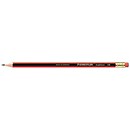
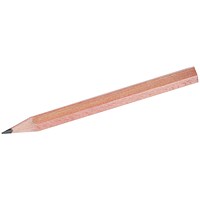
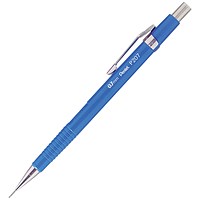
A pencil is a thin rod of solid marking material encased in a cylinder most often made of wood. Pencils can be sharpened to produce varying drawing tips for artistic uses. Although Romans and Greeks used lead for drawing and marking, the pencil “lead” in modern pencils usually consists of pigment and clay, or wax in the case of some coloured pencils.
A very short pencil history
The use of pencils as writing implements is attested from 1565 when Conrad Gesner, a German-Swiss naturalist, described a writing implement in which a piece of graphite was held in wooden casing. Pure graphite is a soft material and so needs casing to be used for marking. In 1795 French chemist Nicolas-Jacques Conté discovered a formula for a mixture of graphite, clay, resins and other chemicals that could be fired in a kiln to produce the more durable type of pencil lead with which we are familiar today.
Conté also found that by varying the proportion of graphite to clay he could vary the hardness of the pencil lead and therefore the lightness or darkness of the line drawn using the pencil. Generally, the harder the pencil the lighter the shade.
Did you know?
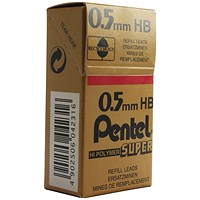
In Europe an HB scale is used to indicate a pencil's hardness where “H” stands for hard and “B” stands for black. For example, a 9B pencil will draw a very dark line while a 4H will produce a much lighter shade. The familiar HB pencil comes somewhere in the middle of the scale.
More pencil facts
- When graphite was first discovered in the 1400s it was given the name “black lead” and was thought to be a form of this metal. Conrad Genser in the 16th century was the first to describe it as a separate mineral but it was not until 1779 that Swedish chemist Carl Wilhelm Scheele showed graphite to be a form of carbon.
- Philidelphian Hymen Lipman is credited with receiving the first patent for attaching an eraser to the end of a pencil in 1858.

